Project Zeal
Lagos State Revenue Optimization Project - led a 7-member team assessing 10 government MDAs
The Problem
Lagos State needed to identify where government revenue could be optimised across 10 Ministries, Departments and Agencies, but had no structured, evidence-based view of the process inefficiencies causing it.
Each MDA ran its own revenue process in its own way. Billing, payment and reconciliation were handled agency by agency, so there was no single picture of how a naira owed to the state actually became a naira collected, or where it dropped out along the way. That is the pattern the wider programme, Project Zeal, was set up to address: siloed processes, inconsistent billing, limited payment channels, and little self-service for the citizens and businesses paying.
The pressure was real. The state was working against a 2024 budget of about ₦2.27 trillion, yet the process-level evidence needed to meet it wasn't there.
Revenue wasn't being lost at the till. It was being lost at the seams between disconnected processes.
The Approach
Rather than assume where the leakage was, I led a 7-member team to look at each MDA from three sides at once:
Surveys gave structured evidence at scale on how each process actually worked and where it caused friction. Mystery shopping meant going through each process the way a real payer would, which exposes what an organisation chart never shows: unclear billing, limited ways to pay, and steps that only work if you already know someone. Executive interviews surfaced the constraints and priorities of each MDA's leadership, so recommendations fit how the agency actually runs.
No finding rested on a single viewpoint. We cross-checked the three sources against each other, then mapped what held up to the programme's own goals: breaking down siloed processes, harmonised billing, centralised payment, more payment channels, and self-service for payers.
The output was a set of actionable strategy recommendations for each MDA, each tied to a specific process step rather than a general principle, so the Special Adviser's office had concrete reforms to prioritise instead of a list of observations.
- Led a 7-member assessment team across 10 government MDAs
- Triangulated three evidence sources (surveys, mystery shopping, executive interviews) so no finding rested on a single viewpoint
- Recommendations mapped to the programme's goals: end-to-end automation, harmonised billing, centralised payment, wider payment channels, and self-service
- Each recommendation tied to a specific process step, not a general principle
- Findings delivered directly to the Special Adviser's office
The Outcome
Findings were delivered directly to the Special Adviser's office and informed revenue-reform and process-improvement priorities across the assessed MDAs.
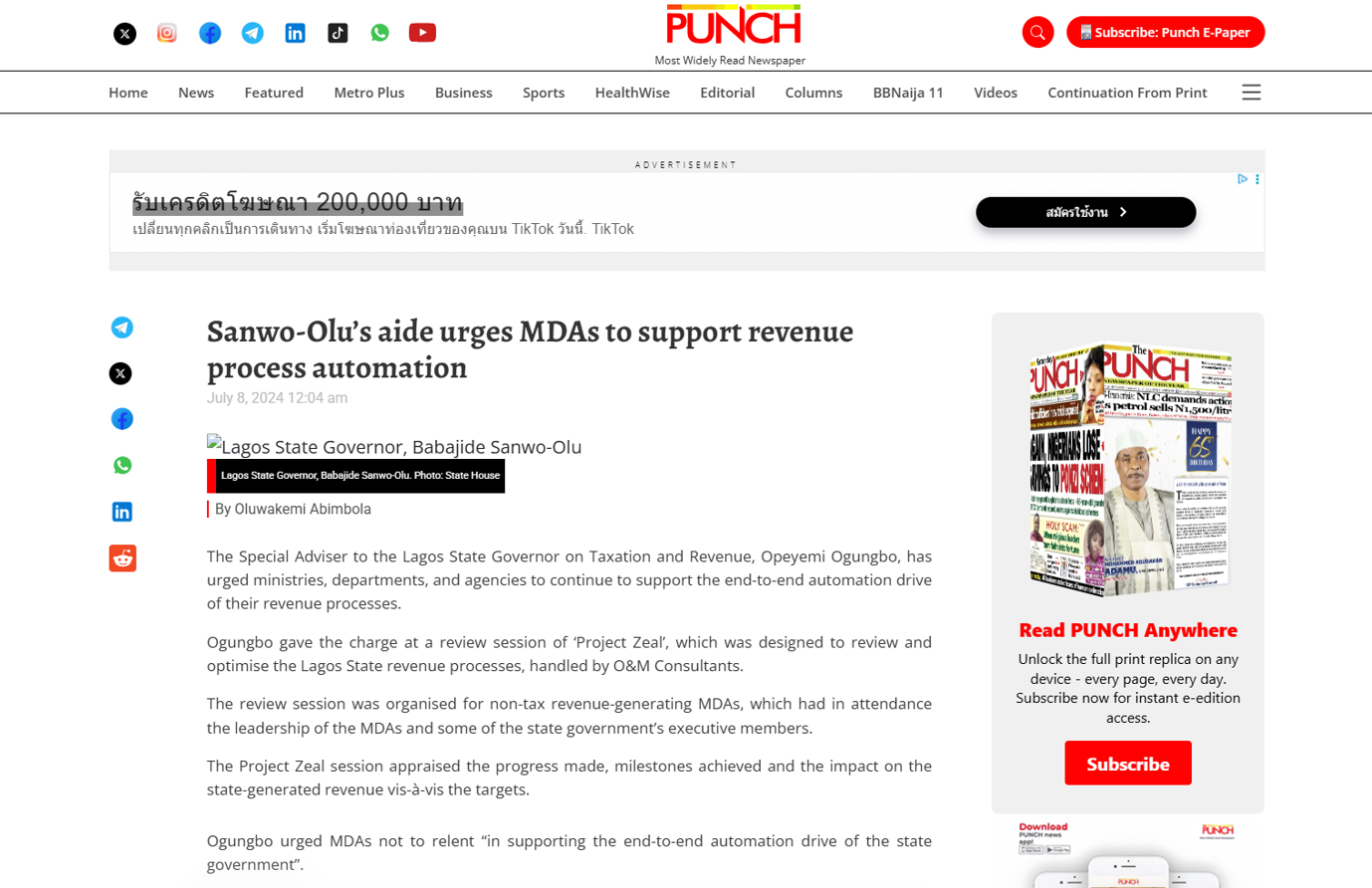
The work sits inside a wider state programme that has been pushed publicly: at a Project Zeal review session in July 2024, the Governor's Special Adviser on Taxation and Revenue urged MDAs to keep supporting the end-to-end automation of their revenue processes, with the aim of exceeding the 2024 budget of about ₦2.27 trillion.